Showing posts with label sustainability. Show all posts

Monday, 4 December 2017

Corporate Social Responsibility

Global interconnectedness and the significance of climate change have increased the need for corporations to be transparent and socially, environmentally responsible:  
General Mills's global responsibility:
 ''we are committed to combating climate change 

by working towards sustainable emissions levels 
by 2050 and reducing GHG emissions by 28% by 2025'' 

 Nestlé has ''further strengthened'' its environmental commitments 
How transparent are corporations' motivations? And, more importantly, how sustainable can major corporations be? Can ''fair trade'', ''organic'', ''sustainable'' labels be deceptive? 

Nestlé promised to end deforestation in its supply chain after its responsibility in deforestation was exposed. I highly recommend taking a look at Greenpeace's  'How Palm Oil is Still Cooking the Climate' (the 'still' was added ten years after the original report in 2007).

Remember this? 


In 2010, Nestlé was Caught Red Handed (in its contribution to the deforestation for Palm Oil) and Greenpeace launched a massive campaign against KitKat (owned by Nestlé)
The bountiful rainforests of Malaysia and Indonesia have helped address the world's thirst for palm oil, currently supplying about 85% of demands and they are not about to have a break. 

Just like corn and other cash crops, palm oil's value comes from its versatility. It is found in half of packaged products sold in supermarkets (and non-food products like biofuel). Significant pledges were made in light of COP21 to cut forest loss by half by 2020. By 2014, governments and corporations adopted 'no deforestation, no peat, no exploitation' (NDPE) policies: 
''Consumers have sent companies a clear signal that they do not want their purchasing habits to drive deforestation and companies are responding'' (Paul Polmann, Chief executive officer of Unilever, 2014). 
The reality is that the industry will continue flourishing (expected to produce 128 million tons by 2022) while forests continue being cleared (see, for example, A Deadly Trade Off). Executive chairman of Malaysia's IOI Group (one of the world's leading palm oil players) is very optimistic, expressing the company's vision to ''widen the geographical spread of palm oil products in the world and push the boundaries where palm oil can be applied and used''. If it produces four tonnes of crude palm oil (CPO) per hectare a year, IOI aims to double it. Indonesia's Minister for Economic Affairs is even more straightforward: “we will not let go of even one tonne of trade contract or potential demand palm has globally”. The country has made plans to convert around 18 million hectares of rainforests into plantations by 2020. 

Companies like Nestlé are shielded from the stains of deforestation with logos that certify their sustainable sourcing. The Roundtable on Sustainable Palm Oil (RSPO) does just that. 


What is 'sustainable'? Source
Making sure the sourcing of companies (and the legitimacy of logos and certificates) is truly sustainable requires tracing the activities back to the plantation levels. The Guardian published an article recently, titled Nestlé, Hersheys and Mars breaking promises over palm oil use. These food brands have reportedly been sourcing their palm oil from the vanishing Sumatran rainforest, where complex supply chains sometimes involve traders linked to illegal logging. 

Update: a new study has determined that the loss of primary forest habitats (from deforestation linked mainly to palm oil exploration) has led ''to an equivocal or higher threat of extinction'' of the Sumatran tiger. Tiger densities were reportedly 31.9% lower in disturbed areas, and, considering that 80% of the Sumatra's remaining hill, lowland and peat forest is already disturbed, forest conservation will determine the fate of Sumatran tigers and other species at the brink of extinction (Luskin et al., 2017).

Governments and corporations are responsible for large-scale land-cover changes and land-use dynamics. Traders should be held accountable for new plantation expansions across their supply chains. On the other hand, the regulators - governments - seem to be shying away from their commitments. 

What do you think?

Saturday, 25 November 2017

Climate-Smart Seeds?

Climate change challenges current practices and calls for innovative, efficient use of resources. 

Considering the impact of rapid and wide-scale agricultural transformations on the Earth System, it is important to discuss the future of agriculture in sub-Saharan Africa (SSA), which lags behind all other regions in agriculture; ''80% of production gains since 1980 have come from the expansion of cropped areas rather than from greater productivity of areas already cultivated'' (Rakotoarisoa et al., 2012). Furthermore, the IPCC clearly demonstrates that the region will experience major yield losses under climate change.

  
The FAO's 2016 and 2017 State of Food and Agriculture reports both include ''adopting varieties resistant to heat and drought'' under the Climate-Smart Agriculture section. Let's take a look at Water-Efficient Maize for Africa (WEMA):


Major agribusiness companies such as Syngenta and Monsanto 
have been promoting hybrids to confront climate change

Non-profit organizations engaged in agricultural development using hybrids

WEMA is a project undertaken by Monsanto, using a patented maize (corn) hybrid aimed at resisting drought and insects, approved for commercial release in Kenya, Mozambique, Uganda, Tanzania, South Africa. WEMA is funded by the Bill and Melinda Gates Foundation, Howard G. Buffett Foundation and the United States Agency for International Development (USAID). It is coordinated by the African Agricultural Technology Foundation (AATF), which qualifies climate change as a major challenge to smallholders in sub-Saharan Africa who ''have little resources to effectively manage''. But what resources do farmers need to become self-sufficient and resilient?

For whom is it a ''smart'' solution?


                                              The FAO's video campaign for Climate-Smart Agriculture

The FAO's youtube video campaign for CSA focuses on the importance of building the resilience of ''the men and women who produce our food’’. Perhaps smallholders are most vulnerable to climate-change and holistic, innovative farming techniques are required. However, the video does not mention agribusinesses and industrial agriculture (the main contributors to agricultural greenhouse gas emissions and therefore the main actors in mitigation) and focuses solely on small-holder farmers.


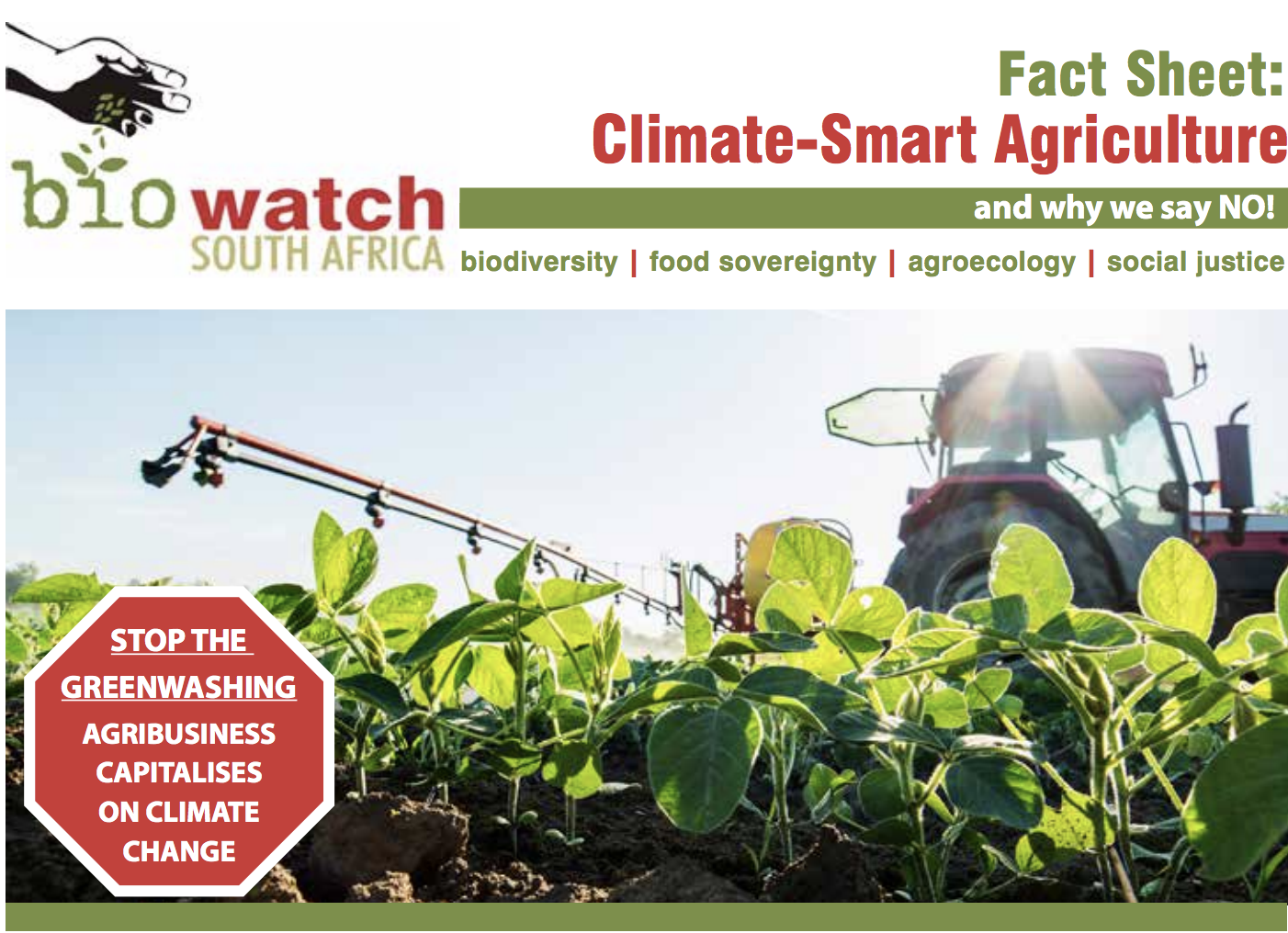
Denouncers of CSA (see BioWatch, ACBio, Green Social Thought) claim that with the pretext of helping smallholders combat climate change, ''under the guise of philanthropy'', TNCs such as Syngenta and Monsanto seek to establish a private sector-driven seed industry in Africa; ''hybrid seeds are capturing African markets at a rapid pace and represent an average of 57% of maize seed grown on the continent''.

''Using the language and even some of the methods of ecological agriculture, climate-smart agriculture provides a veneer of sustainability for interventions that continue to promote industrial agribusiness products and technologies”- BioWatch South Africa 

What do you think?

Friday, 27 October 2017

What the world eats


Hey everyone! I came across an interesting series of photographs taken by photo-journalist Peter Menzel for his book called ''Hungry Planet: what the world eats''. Here are a few:

The Melander family from Bargteheide, Germany, with a week's worth of food. Food expenditure for one week: $500.07 USD

The Caven family. American Canyon, California, with a week's worth of food. Food expenditure for one week: $159.18 USD
The Mendoza family in Todos Santos Cuchumatán, Guatemala, with a week's worth of food. Food expenditure for one week: $75.70 USD

The Ayme family in their kitchen house in Tingo, Ecuador, a village in the central Andes, with one week's worth of food. Food expenditure for one week: $31.55 USD

Powerful images, right? 

Recent studies (Behrens et al., 2017) show that there is an increasing demand for foods with high environmental and health impacts. Meat consumption has grown unprecedently over the past decades, putting pressure on forests and resources. Animal products are considered a ''luxury'' food for rural populations, whereas they have become widely available and accessible in urban areas.

The first family, from Germany, spends three times as much as the American family, including many beverages, and what appears to be higher quality meats. The American family seems to eat a lot of ''brands''. Compared to the rural, the urban families eat little "natural" foods and mostly processed foods. It is also interesting to notice the food expenditures. For urban families, the ability to spend more on food reflects socioeconomic status, whereas rural families reflect wealth from the amount of food available. How much would it cost for the German family to consume as much (organic) produce as the Guatemalan's?

Equilibrium?

The supply of animal products depends on reproductive capacity, and natural resources, in general, have an equilibrium harvest. Can we say our current agro-industrial practices are unsustainable? What are the interactions between the social and the biological system when we think of our food? 

Should we think of our global food production systems as major drivers of change in terms of the linear consumption patterns of societies? 


Many questions with perhaps a variety of complex answers...